Posted on 4 Comments

Financial Independence Core Principle #2: Start Early to Realize the Power Of Compound Interest

Have you ever wondered why people talk about investing early in your life? The simple reason is the power of compound interest. If you start investing early in your life you will realize the power of compound interest and will greatly speed up your path to FI. This is an incredible way to build wealth at a young age.

Want to see what the power of compounding can do? You can see a simplified compound interest calculator here, you can input a few numbers to see what the power of compound interest looks like.
Let’s take the below example over a 30 year timespan:

  • You started with an investment of $500
  • You add $100 to this investment every month
  • Let’s assume this investment earns you a 7% return

What Does Compound Interest Look LikeIn the above example, here is what your money would look like after 30 years!

What are we looking at? The y-axis indicates the dollar value. The x-axis indicates the number of years. The blue/green line shows the amount you contributed over time and the red line shows the future value of the money after compounding.

Here is what I find most interesting about compound interest. Early on in the investment, you won’t see much difference between the red and blue/green lines. For example, in the graph above, you don’t see much difference in the two lines until year 14. This would make most believe the strategy isn’t working. Some would quit. Some would think they wasted a bunch of time. But wait, there is more.

It is the later years where you begin to truly see the separation. Beginning around year 14 we begin to see exponential growth take place. Growth compounded on more growth will only speed up this curve faster as you look further out.

Don’t believe me, let’s look at what a 50 year time horizon would look like:

But What If I Didn’t Start Early?

This is a very common question I get. Many believe if they don’t start early then they should not start at all. This is part of the challenge of having a Fixed vs Growth mindset. If you want to read more about what the difference of theses mindsets, click here.

Don’t let the fact that you didn’t start young stop you from starting! You learn new information every day. Take the new information you learn each day and figure out how to apply what is relevant. Investing in your future self and the ability to become financially independent will always be relevant.

Key Takeaways:

  • The power of compound interest is real. Be patient and start early!
  • If you haven’t started yet and you aren’t young, SO WHAT! Start now. Don’t let this be the excuse to never get started.
  • The longer you look out on a compound interest timeline, the more compounding you see. This is true for any scenario you plug into the calculator.

As always, don’t forget the first core principle: Your money should make money for you.
Posted on Leave a comment

Analyzing A Short Term Rental Investment – Understanding the Inputs

Analyzing a short term rental investment for cash flow is critical to know if there is financial sense to the property you are looking at. With that, I wanted to share the sensitivity analysis spreadsheet I have created to analyze a short term rental investment. Let’s jump straight into analyzing a short term rental property with first understanding the numbers!


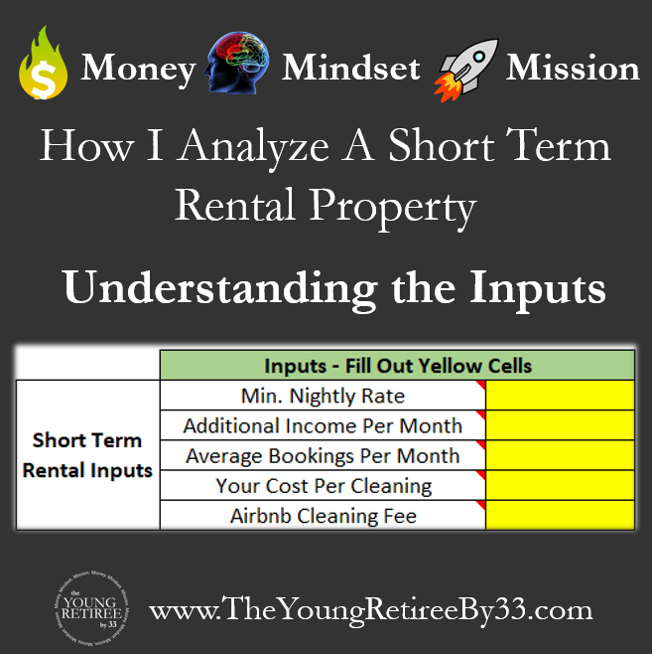
Understanding The Inputs There are three different types of inputs you will need to understand before you can effectively analyze a property. Below is a screenshot of all the inputs we will use to analyze a property.

Inputs we will discuss for short term rentals.

Short Term Rental Inputs

First, you need to understand a good base price for your nightly rate. There are many ways to come up with this number, but the goal is to set a conservative number for this. This number is used to as the minimum price you will charge per night for offseason. In almost every short term rental market, there are high seasons and low seasons. The number input into this cell should be what you feel comfortable having as a nightly rate for off season.

To get this number, I would go to Airbnb, and search for a certain number of guests and leave the dates unchecked. This will bring back the top listings that can accommodate that number of guests. You will want to do this and then go into specific listings and click on their calendar for dates in the offseason. See what nightly rate comes up. Click into 10-15 listings to get a good understanding of what the nightly rate is. There are other factors you will need to consider, i.e. location, amenities, private pool, etc. so try to find properties that match yours.

Second, determine whether you can generate extra income each month for your property. Here are a few ways you can generate extra income from your property

  • Offer an early check-in for $20
  • Offer to heat the pool if the guest asks for $20/day
  • Offer a late checkout for $20
  • Offer extra cleaning services if someone has a long stay

There are other ways you can generate extra income, but those are some of the things I have used. For my Airbnb, I generate between $40-100 of extra income a month.

Third, it is important to estimate how many different bookings you expect per month. Why? This will help you understand cleaning costs. Each time you have a new group staying at your place, you will charge them a cleaning fee and you will pay a cleaner. This brings us to our next input.

Next, you will have the cost for you to pay a cleaner to turn the property. If you want to take on the extra work, you can clean yourself and in this case the cost would be $0. If you are like most short term rental hosts, you will pay a cleaner to turn the property. Call cleaners in the area to get an estimate of the cost per cleaning for the size of your property. Get a few estimates and again, be conservative with this number.

Finally, you have your Airbnb Cleaning Fee. This is the extra charge to your guest for cleaning the property. That’s right, you don’t have to take money out of your pocket to pay for cleaning. Pass this charge along to your guest. This is completely normal in the short term rental space. Go through different listings in your area to see what people are charging for cleaning. Personally, I charge $110 per cleaning to my guest, and my cost for my cleaner is $100. This means I “profit” $10 per turn. This money will go towards replacing anything that needs to be replaced after a guests stay.

Key Takeaways:

  • There are key inputs to properly analyzing a short term rental property. Understanding these inputs will help you better analyze properties
  • Use your competition in the area to get more accurate data for your inputs. I actively use my competition to see their prices for both nightly and cleaning rates.
  • Don’t forget that you can “make money” from cleaning fees. There is no reason to eat this cost entirely. I make $10 per turn and this becomes extra income I use for replacing common things that get damaged in the home.

Don’t forget @TheYoungRetireeBy33’s 3 Core Principles:

1 – Your money should make money for you⠀⠀⠀⠀⠀⠀⠀⠀⠀
2 – Start early to realize the power of compound interest⠀⠀⠀⠀⠀⠀⠀⠀⠀
3 – Eliminate your largest expense by house hacking

Posted on 7 Comments

Financial Independence: Core Principle #1

I have been thinking about creating core principles to my to my content for a while. It is finally time to to solidify three core principles I will continue to reference on each post.


Here we go!


Core Principle #1: Your Money Should Always Make Money For You

Core Principal #1

What do I mean by this?

  • Don’t keep cash sitting in a bank account earning 0.01% interest.
  • Don’t keep physical cash on you
  • Don’t go digging a hole and store your cash in the backyard

How My Understanding Of Money Has Evolved

I have made my fair share of mistakes after graduating college. Mistakes that I hope many can learn from. The single biggest one was not having my money invested and thinking I was doing things right by having a lot of cash in my savings account.

My parents didn’t teach me anything about money to be honest. There were never household conversations where I learned about investing or saving. Once I graduated from college, I was off into the real world of the 9-5 bull s****. Getting a paycheck every two weeks that would direct deposit to my bank account. I had no idea what to do with the money, so I decided to let it sit in my Bank of America Savings account. This account was earning me 0.03% interest. I had no idea there were things I could be doing with the money versus letting it sit in cash earning a terrible interest rate.

The Greatest Lesson I Eventually Learned

The single greatest lesson I learned about money was ensuring your money was always working for you. You want your money to be creating more money soldiers!

Your money can’t make money for you if you don’t have it properly invested. This principal isn’t meant to outline where to invest your money. The main point is that your money should always make money for you.

Key Takeaways

  • Your money should always be making money for you. Period.
  • Don’t keep cash sitting in an account earning less than 1%
  • Don’t be overwhelmed by the different types of investments available to pursue. Do your research and move your money to a spot where you feel it has the best chance to multiply.

Don’t forget @TheYoungRetireeBy33’s 3 Core Principles:

1 – Your money should make money for you⠀⠀⠀⠀⠀⠀⠀⠀⠀
2 – Start early to realize the power of compound interest⠀⠀⠀⠀⠀⠀⠀⠀⠀
3 – Eliminate your largest expense by house hacking